Most of us are used to writing JavaScript code for a long time. But we might not have updated ourselves with new features which can solve your issu...

For further actions, you may consider blocking this person and/or reporting abuse


Do some performance testing of both codes in first example and see the difference
On both iOS Safari/Chrome/Firefox it is 90% slower, on Desktop except chrome, Safari and Firefox are 90% slower.
It's also exhausting how often claiming "premature optimization" is used to justify sloppy thinking.
Don’t pessimize prematurely:
Alexandrescu, Andrei. "Modern C++ Design: Generic Programming and Design Patterns Applied", Small Object Allocation, p.77, 2001.
Stated differently:
Rich Hickey:
V8 is an amazing piece of technology but its heuristics are so complex that the smallest thing can derail JavaScript performance, so it's very inconsistent — at least when compared to languages that are compiled prior to deployment. From that perspective it makes sense to feed it code where is doesn't have to "guess" too much.
WebAssembly for Web Developers (Google I/O ’19):
And finally in the face of the continued proliferation of low-power / low-end / low-spec / small-core devices it seems foolish to rely on the JIT having access to the necessary CPU cycles to reliably optimize the code in a reasonable amount of time at runtime (perhaps we need profiling transpilers - but establishing representative "real-world" operational profile(s) can be a challenge in itself).
Meanwhile the self-improvement industry is pushing for aggregation of marginal gains - which is all about eliminating pessimization.
In the meantime real-life users have to deal with this.
||is as outdated asfunction. These two operator have two drastically different semantics:||in case left-hand value is falsy.??in case left-hand value is not defined (undefinedornull).Both have their usage and are not interchangeable.
??is great whenfalseis an intentional value.Parenthesis in functions is not something you should spend your time on, use Prettier.
On Firefox, the
||method was almost twice as fast asincludes. So, if there's almost no difference on Chrome, and a big difference in favour of||on Firefox,||would seem the better choice overall for performance? jsbench.me/njkuruuurr/1On mobile, difference is 90%, try it and then see. You are creating an array, unnecessary memory allocation and calling a method, which are multiple cpu cycles. Compound it multiple time used in single script it is by far the worst practice.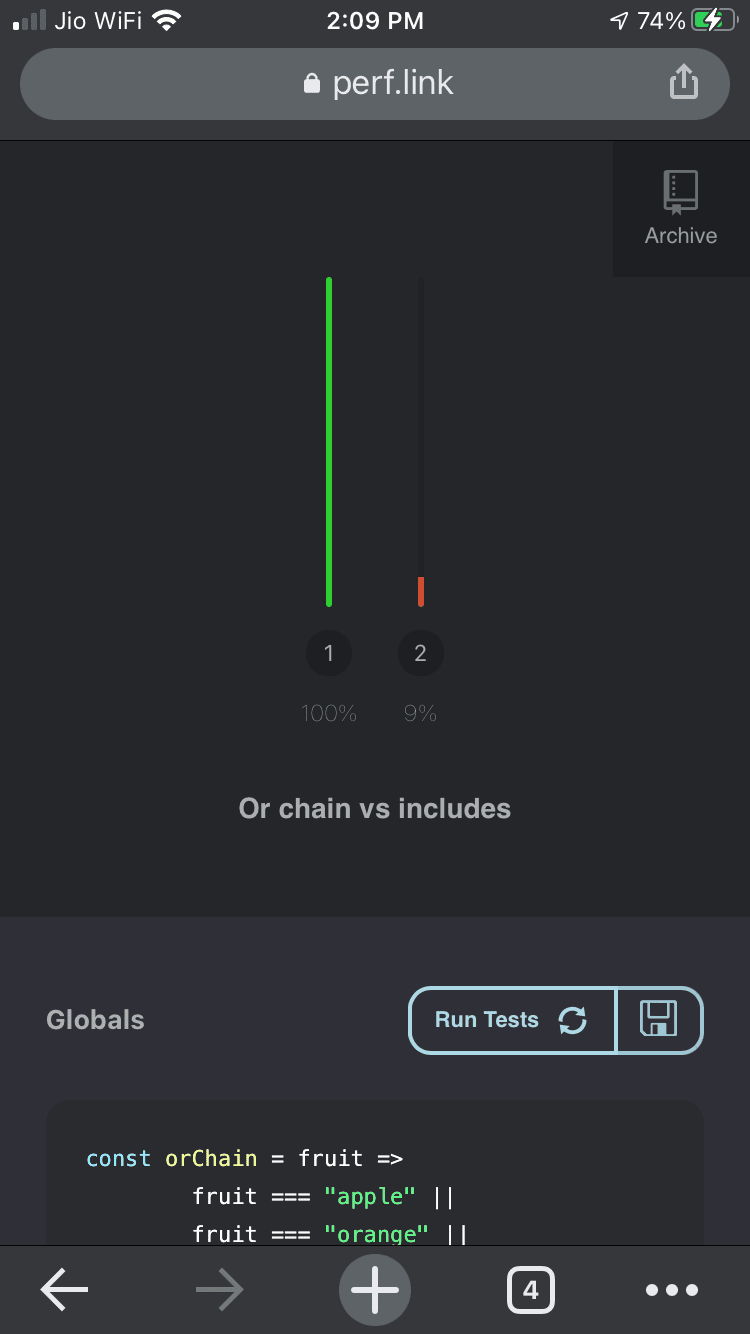
90% ? are you kidding me ? talk is cheap, show me your testing.
Globally Apple has a 15% Marketshare, 53% in North America, 32% in Europe — those users are locked into a "shitty browser" and not willing to forego their other creature comforts they are not going to switch brands on your account.
Meanwhile Chrome even on desktop has a reputation for being CPU and memory hungry. Apparently some people want lighter-weight alternatives. One has to wonder how pessimized JavaScript performs on Google GO on a "shitty phone".
Strong disagree on using
=>overfunction. You'll have a confusing time withthis.You should not use "this" in modern JavaScript in the first place.
Because?
Because it doesn't promote arguably better immutable state.
But hey, it's a bold statement and I wouldn't say it always applies.
For #1, another option is to use
findinstead. That way it stops execution on the first found match.iPhone 6s Plus iOS 14.7.1


While Safari is primarily to blame here, this phone's CPU is still better than what's on a lot of contemporary run-of-mill android phones.
Its impossible to respond in a thread after some levels of nesting so I will just go and post in top level adding to one part of it:
I also think people think about "performance" too narrowly. Developers performance matters. Especially since JIT compilers progress every year and find new ways of applying those microoptimizations. In the IE days it was very often the case that one microoptimization would be an antipattern next version, because engine strategy was so much better.
These are good tips:
The performance difference is irrelevant, the array includes way feels cleaner but is actually harder to read because you don't immediately see what you're comparing the value to, and the more items in the list, the farther away the variable is visually so it actually makes the code harder to understand for even slightly more complex lists.
Optional chaining is terrible terrible and let me say it again, terrible.
See. If obj?.address?.postalCode fails, you don't know if obj doesn't exist, or obj.address doesn't exist or if it's just the obj.address.postalCode that's missing.
This WILL [not can] lead to problems where no error happens even though an important piece of information is missing and debugging it is a mess where you end up splitting it up anyway so it's better to validate each part of the object exists before using it.
You'll never do second=first....if so you would just use "first" in the first place.
That scenario literally never happens unless you're writing extra code and creating extra variables you don't need.
I like this one, i usually use arrays for it, but objects work too.
If a function has one line in it...it shouldn't be a damn function. That level of abstraction makes systems a bloody nightmare to debug because you're jumping 20 functions deep to find the culprit and often in 20 different files. Just KISS dammit.
Would be interesting to also see performance benchmarks on each pair
Such posts always inspire me to write another article why radical opinions are always wrong.
Owning an iPhone doesn’t mean you have to use safari, it is the default sure but you can install Firefox, brave, or if spyware is your jam Chrome.
But those browsers all use the Safari engine under the hood, Apple won't allow anything else
Yeah, that's why I mentioned "falsy" values, not false explicitly.
Where can you learn more tricks like this?
Android has V8 engine so it performs same as desktop, Safari and Firefox has different results.
Is it Android or iPhone?
let first = 0
const second = first || ''
second // ''