

Your Pipeline Is 15.9h Behind: Catching Software Sentiment Leads with Pulsebit
We just uncovered an intriguing anomaly: a 24h momentum spike of -0.713 in software sentiment. This significant downturn is not just a random fluctuation; it’s a signal that something is brewing beneath the surface. The leading language for this anomaly is English, with a lag of 15.9 hours, which means if you were relying solely on this data in a monolingual context, you missed a critical window to act. This is not just an oversight; it’s a structural gap in your pipeline.
If your model doesn’t handle multilingual origins or entity dominance, you could be missing out on crucial insights. In this case, your model missed this by a staggering 15.9 hours, leaving you behind the curve as the sentiment around software took a dive. The leading entity, driven by the recent acquisition of Vertica by Rocket Software, is indicative of a larger narrative that your model may not be capturing fully.

English coverage led by 15.9 hours. Et at T+15.9h. Confidence scores: English 0.80, French 0.80, Spanish 0.80 Source: Pulsebit /sentiment_by_lang.
Let’s get into the code that could help you catch these sentiment shifts in real-time. First, we’ll use our API to filter for English-language articles on the software topic. The following Python code snippet demonstrates how to make this API call:

Left: Python GET /news_semantic call for 'software'. Right: returned JSON response structure (clusters: 3). Source: Pulsebit /news_semantic.
import requests
# Set the parameters for the API call
params = {
"topic": "software",
"lang": "en", # Geographic origin filter
"momentum": -0.713,
"score": -0.600,
"confidence": 0.80
}
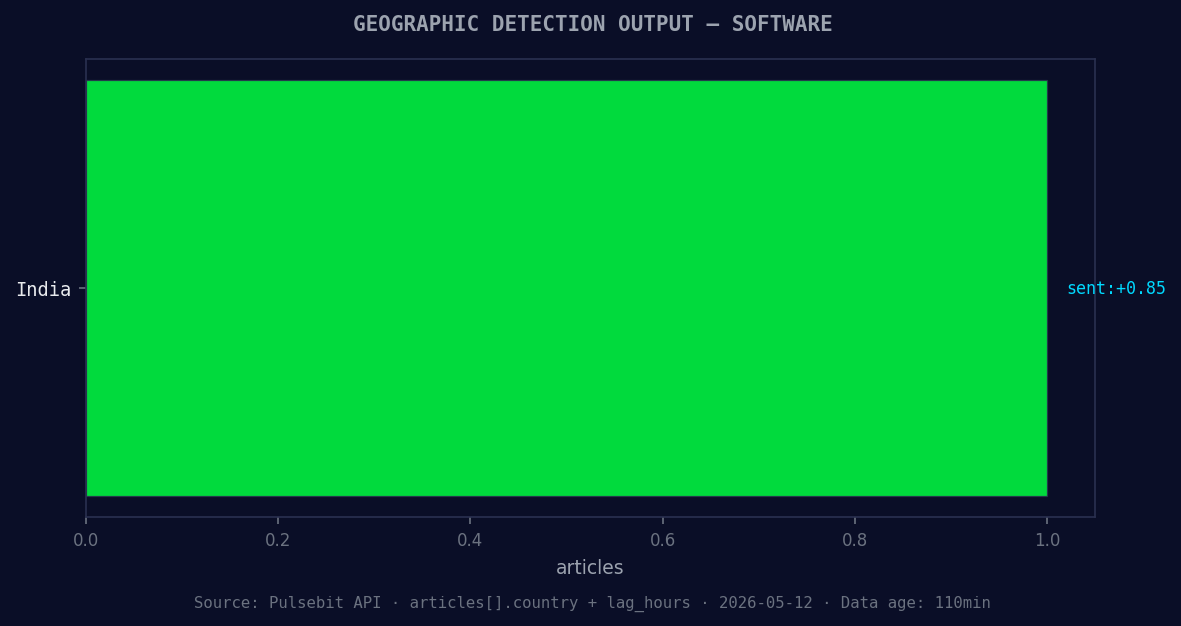
*Geographic detection output for software. India leads with 1 articles and sentiment +0.85. Source: Pulsebit /news_recent geographic fields.*
# Make the API call to fetch the sentiment data
response = requests.get("https://api.pulsebit.com/v1/sentiment", params=params)
data = response.json()
print(data)
Next, we want to delve deeper into the narrative surrounding this sentiment shift. We can run the cluster reason string through our sentiment analysis endpoint to score the narrative framing itself. Here’s how you can achieve this:
# Meta-sentiment moment: analyze the narrative framing
narrative = "Clustered by shared themes: software, completes, acquisition, vertica, rocket."
meta_sentiment_response = requests.post("https://api.pulsebit.com/v1/sentiment", json={"text": narrative})
meta_sentiment_data = meta_sentiment_response.json()
print(meta_sentiment_data)
By leveraging these two API calls, you can identify not only the immediate sentiment shifts but also the underlying themes that are contributing to those shifts.
Now, let’s explore three specific builds you can implement tonight based on this pattern.
Geo-Filtered Alert System: Set a threshold for sentiment drops in the software sector. If the sentiment dips below -0.600 and the originating language is English, trigger an alert or an automated response to your team.
Meta-Sentiment Score Tracker: Create a tool that continually runs the narrative framing through our sentiment endpoint whenever a significant sentiment spike or drop is detected. Use the narrative from the cluster, such as "Clustered by shared themes: consolidated, sonata, software", to get timely insights.
Thematic Sentiment Dashboard: Build a dashboard that visualizes the sentiment of key themes in real-time. For example, track how sentiments around "software", "Google", and "says" are forming in contrast to mainstream narratives like "consolidated" and "sonata". This will allow you to understand sentiment trends across multiple dimensions.
We encourage you to explore our documentation at pulsebit.lojenterprise.com/docs. With these examples, you can copy-paste this code and start running your analysis in under 10 minutes. Don't let your pipeline lag behind; catch those sentiment leads while they’re hot!


Top comments (0)